
Eat well on your GLP-1, without losing muscle, hair, or your week to meal-planning.
For people on Ozempic®, Wegovy®, Mounjaro®, Zepbound®, or any GLP-1 receptor agonist. Small-portion, high-protein, gentle-on-the-stomach plans built around what you can actually eat this week, not what the box says you should.
25–35g
Protein per meal target
5–6
Small meals/day, planned
$19.99
/month · cancel anytime
GLP-1s change how you eat. Most meal services don't.
Six things you're probably dealing with, and what your weekly plan should do about them.
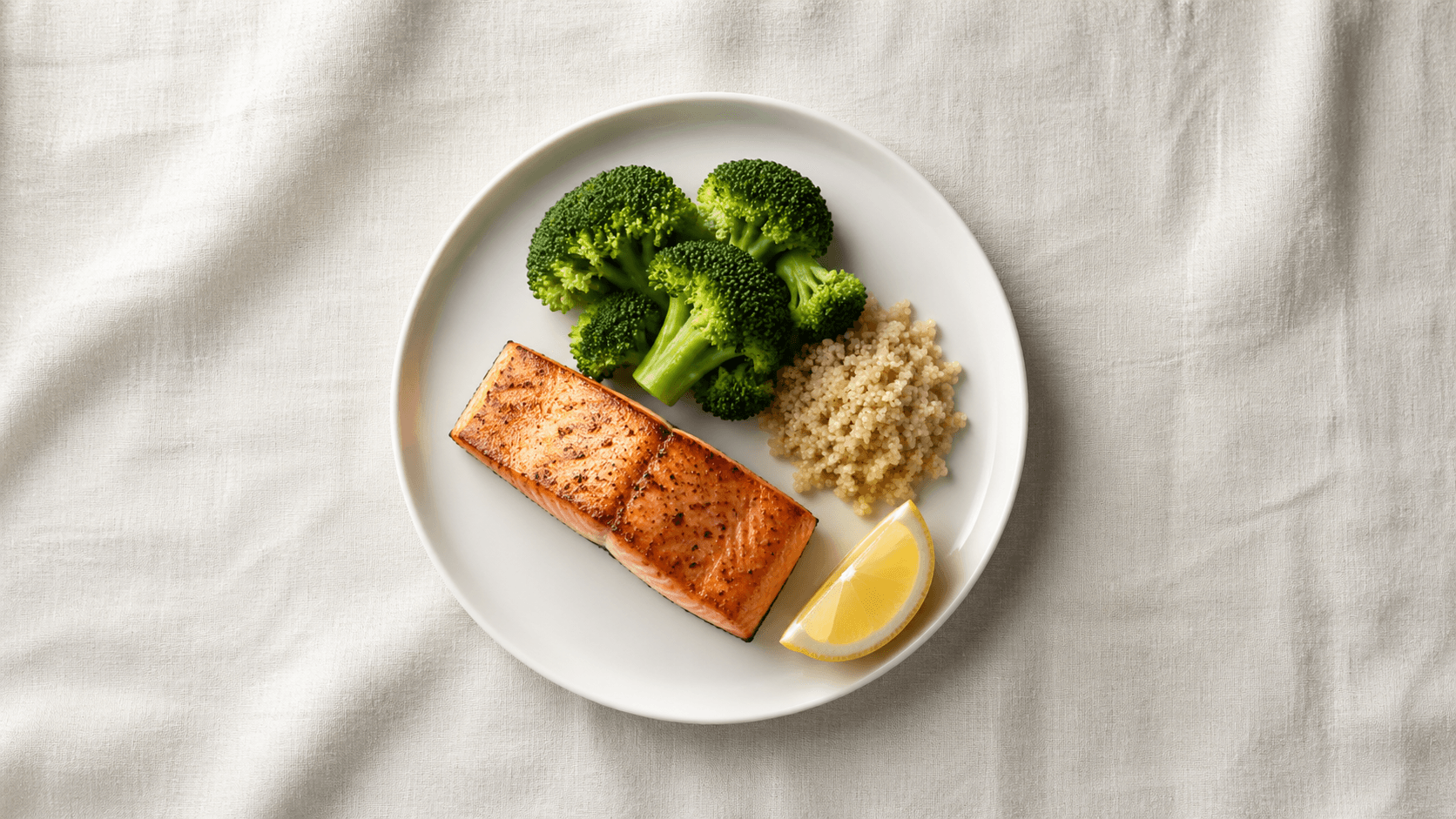
 What a normal plate looks like vs. what you can actually eat on a GLP-1.
Food noise comes back
Between doses or as your body adjusts, the constant food chatter returns. A planned week removes the daily negotiation. You don't decide three times a day what to eat, you just follow the plan.
"Two bites and I'm full"
Reduced appetite is the point, but it means you skip meals, miss protein, and lose energy. We plan 5–6 small eating occasions instead of 3 big ones, so getting your protein and calories in actually fits your stomach.
Hitting your protein target
Up to 40% of weight lost on a GLP-1 medication can be lean muscle mass. We anchor every plan around the 1.2 g/kg/day floor recommended by registered dietitians, split into 25–35g servings your body can actually use.
"The meat ick" / metallic mouth
Aversions hit ~70% of users. Eggs, red meat, coffee, fried food suddenly feel disgusting. Tell us this week's aversions; the planner routes around them and pulls in foods most GLP-1 users still tolerate well (salmon, broccoli, brussels, Greek yogurt).
Sulfur burps + nausea
Greasy and high-fat meals trigger delayed gastric emptying. That's the rotten-egg burp and the nausea. We default to lean proteins, gentle fiber, and skip the fried/heavy-spice triggers. Plenty of options that taste good cold or room-temp when heat makes you queasy.
Forgetting to drink
GLP-1s suppress thirst. Dehydration makes the side effects worse and stalls weight loss. Plans lean toward hydration-forward foods (soups, citrus, melon, cucumber), and your shopping list flags it.
Why a planner beats a meal kit on a GLP-1
Meal kits ship food. On a GLP-1, your appetite, aversions, and tolerance change week to week. You need a plan, not a freezer full of trays you can't finish.
 5–6 small eating occasions across the day. How the plan actually fits a GLP-1 stomach.
Frozen trays don't flex with your week.
Ships 10 frozen trays you only eat 4 of
Can't adapt when "the meat ick" hits this week
Pre-cooked portions don't scale with your appetite swings
No way to factor in your dose week or side-effect day
Locked-in subscription, food waste guaranteed
A week that bends to your appetite, not against it.
Plans the week around your appetite, dose, and aversions today
Re-plan Tuesday when the eggs suddenly taste wrong
Portions scale per person, per meal: small now, normal later
Your protein floor (1.2 g/kg) is enforced by the plan, not by guesswork
You buy what you'll actually eat. Grocery list updates with every swap.
“On a GLP-1, you're only able to eat about 50% of what you used to. Every bite has to count.”
Paraphrased from registered dietitian guidance published by UCHealthBuilt around the numbers that actually matter
The 2025 joint advisory from the Obesity Medicine Association, ACLM, ASN, and The Obesity Society lays out the nutrition priorities for GLP-1 patients. Your plan respects them.
Aligned with guidance from:
1.2 g/kg/day
Protein floor
Canonical recommendation from the PROT-AGE expert consensus for adults; higher (1.2–1.5 g/kg) for adults over 65 or with comorbidities. Your plan enforces the floor.
Bauer et al., J Am Med Dir Assoc 201320–40g
Per eating occasion
Dose-response work shows ~20g maximally stimulates muscle protein synthesis in young adults; older adults need ~30–40g per meal to overcome anabolic resistance. Spread across 5–6 small meals.
Moore et al., Am J Clin Nutr 20098–10
Glasses water/day
GLP-1s suppress thirst, and dehydration makes nausea, constipation, and fatigue worse. Plans lean toward soups, citrus, melon, and cucumber to make hydration passive instead of a chore.
Joint advisory: Mozaffarian et al., Obesity 202520–40%
Of weight lost can be lean mass
SURMOUNT-1 DXA substudy reports ~25% on average; systematic review of semaglutide trials reports a 0–40% range depending on protocol. The protein and resistance plan is what determines where you land.
Look et al., Diabetes Obes Metab 2025; Bikou et al., Expert Opin Pharmacother 2024 Hydration-forward foods make 8–10 glasses passive instead of a chore.
Simple Pricing
One price. Everything included. Cancel any time.
Choose the plan that fits your family size
Family
Most popular for families
$3.33 per person · about $5/week
or $199/year (save $41)
Up to 6 family members
Unlimited meal plans
AI-powered recipe generation
Smart shopping lists
Food group tracking
Per-member dietary preferences
Allergen protection (5 layers)
Recipe ratings & learning
16 supported diet types
Mobile app included
Extended
For large & blended families
Unlimited members
or $299/year (save $61)
Unlimited family members
Unlimited meal plans
AI-powered recipe generation
Smart shopping lists
Food group tracking
Per-member dietary preferences
Allergen protection (5 layers)
Recipe ratings & learning
16 supported diet types
Mobile app included
What families typically pay for nutrition planning
Roughly what it costs to have someone plan balanced meals around each family member's preferences, allergies, and dietary needs.
Initial registered dietitian consultation
$100 – $300
Monthly dietitian follow-up sessions
$75 – $150 each
Family nutrition packages
$300 – $800 / month
Noom (psychology + food logging)
~$70 / month
MyFitnessPal Premium (tracking only)
$19.99 / month
ThisWeekEats Family
$19.99 / month
Important: ThisWeekEats is a meal planning software tool. It is not a registered dietitian, not a doctor, and not a medical service. Prices above are shown as market reference points, not claims of equivalence. A registered dietitian works alongside your physician using your medical history, labs, and conditions, and software cannot replace that relationship. Always consult your physician and a registered dietitian before making dietary changes, especially if you have any medical condition, take medications, are pregnant or nursing, or manage allergies or food sensitivities. Use of this software is at your own discretion.
Questions GLP-1 patients ask us
Straight answers, no marketing hedge.
Yes. ThisWeekEats™ is built for people on any GLP-1 receptor agonist, including semaglutide (Ozempic®, Wegovy®). Your plan adjusts to small portions, the protein-floor target, and the gentler-on-the-stomach foods most semaglutide users tolerate well. We are not affiliated with Novo Nordisk and this is not medical advice.
Yes. Tirzepatide (Mounjaro®, Zepbound®) is mechanistically different from semaglutide (dual GLP-1 plus GIP), and side effects often hit harder, especially in the first weeks of a new dose. Plans default to lean proteins, low-fat preparation, and bland-but-nutrient-dense options. We are not affiliated with Eli Lilly. Talk to your prescribing clinician before changing your diet.
A meal kit ships pre-cooked food on a fixed schedule. On a GLP-1, your appetite, aversions, and tolerance change week to week, and freezer trays don't flex. ThisWeekEats™ plans a week around what you can eat right now, scales portions per person, and re-plans the moment something stops working (e.g., the eggs suddenly taste wrong). You buy what you'll actually eat.
Up to 40% of weight lost on a GLP-1 medication can be lean mass without a deliberate protein and resistance plan. Every week's plan enforces a 1.2 g/kg/day protein floor (the registered-dietitian-published target), split into 25–35g servings spread across 5–6 small eating occasions. That's the dose your body can actually use for muscle protein synthesis. We are a meal planner, not a fitness program; pair this with resistance training advised by your clinician.
Yes. Each family member rates 169+ foods on their own profile, and you can update aversions any week. The planner routes around them and pulls in foods most GLP-1 users still tolerate well: salmon, broccoli, brussels sprouts, Greek yogurt, white-meat poultry. When the aversions shift again next month, you re-rate and the plan follows.
Yes. Delayed gastric emptying is what causes both. Fried, greasy, and high-fat foods make it worse. Plans default to lean proteins, gentle fiber, and skip the common GI triggers (fried foods, mature cheeses, heavy spice, carbonation, alcohol). We can also lean toward foods that taste good cold or room-temperature for the days when heat makes you queasy.
No. ThisWeekEats™ is a meal-planning software tool. It is not a registered dietitian, not a doctor, and not a medical service. The targets and plans on this page are general nutrition guidance based on published RD sources and the 2025 joint advisory of the Obesity Medicine Association, ACLM, ASN, and The Obesity Society. Always consult your prescribing clinician and a registered dietitian before changing your diet, especially while on a prescription medication.
No. ThisWeekEats™ is not affiliated with, endorsed by, or sponsored by Novo Nordisk, Eli Lilly, or the makers of any GLP-1 receptor agonist medication, including Ozempic®, Wegovy®, Mounjaro®, or Zepbound® (registered trademarks of their respective owners). We exist to help people on these medications eat well. That's it.
ThisWeekEats™ Family is $19.99/month for up to 6 family members ($199/year, save $40). Cancel any time. A registered dietitian session typically runs $75–$300. We are not a substitute for one; we're the weekly-execution layer between dietitian visits.