
Why Eggs Suddenly Taste Wrong on Wegovy® (And What Still Works)
By ThisWeekEats Team
April 27, 2026
10 min read
Why Eggs Suddenly Taste Wrong on Wegovy® (And What Still Works)
You used to love eggs. You ate them three days a week for ten years. Now you crack one open, smell it, and your stomach turns.
You're not imagining it, and you're not alone. Across patient-community surveys and registered-dietitian commentary, food aversions are one of the most-reported non-GI experiences on GLP-1 therapy — alongside the well-documented gastrointestinal side effects. The pivotal semaglutide trials documented the GI side: a pooled analysis from STEP 1–3 (Wharton et al., Diabetes Obes Metab 2022) reported nausea in 43.9% of patients on semaglutide 2.4 mg, vomiting in 24.5%, diarrhea in 29.7%, and constipation in 24.2% — most events mild to moderate and transient. Food aversions and taste changes appear to compound on top of these GI symptoms, and many patients report heightened sensitivity to specific flavor profiles — sweetness, saltiness, or what's commonly described as "metallic mouth."
The internal community has names for this: the meat ick, the egg ick, the coffee that suddenly smells like burnt rubber. None of these are in the Wegovy® patient leaflet, but they're some of the most-discussed experiences in r/Ozempic, r/Wegovy, and the GLP-1 patient communities on Facebook.
This article explains what's actually happening, what foods most semaglutide users (Ozempic®, Wegovy®) and tirzepatide users (Mounjaro®, Zepbound®) still tolerate, and how to keep your nutrition on track when half the foods you used to eat now feel wrong.
What's actually happening
GLP-1 medications change three things that affect how food tastes and feels:
1. Delayed gastric emptying
Your stomach empties more slowly on a GLP-1. Food sits longer, fermenting slightly, which is why "sulfur burps" (the rotten-egg burps that come 1–4 hours after a heavy meal) are so common. The longer-residence-time effect is also why high-fat or high-fiber foods that used to be fine now sit like a brick. Your gut is telling you, accurately, that those foods are now harder to digest.
2. Changed central appetite regulation
GLP-1 receptors aren't only in the gut — they're in the brain regions that regulate hunger, reward, and food motivation. The reward signal you used to get from foods you loved (the dopamine hit from a bite of bacon, a sip of coffee, a piece of dark chocolate) is partly muted. What's left is the texture, smell, and association — which can suddenly feel disgusting without the reward layer to balance it.
This is what patients mean when they say "food noise is gone" or "food just feels different." The physiological food-reward circuitry is being modulated by design.
3. Heightened sensitivity to specific flavor profiles
Many GLP-1 users report that things they barely noticed before now taste overwhelming — the sweetness in fruit, the saltiness in cheese, the metallic edge in red meat. The mechanism isn't fully understood, but it's reported consistently enough that registered dietitians now expect it.
The foods that most often go on the "ick" list
A University of Pennsylvania research group used AI to analyze 410,198 Reddit posts across r/Ozempic, r/Mounjaro, r/Semaglutide, r/Wegovy, and related subreddits (summary via MedicalXpress) — finding that 43.5% of posts mentioned at least one side effect, with food aversions appearing prominently alongside GI symptoms. Across that data plus registered-dietitian commentary compiled by SkinnyRx and the 2025 joint advisory (Mozaffarian et al., Obesity 2025) which addresses GI symptom management as one of its eight nutritional priorities, the foods most commonly rejected by GLP-1 users include:
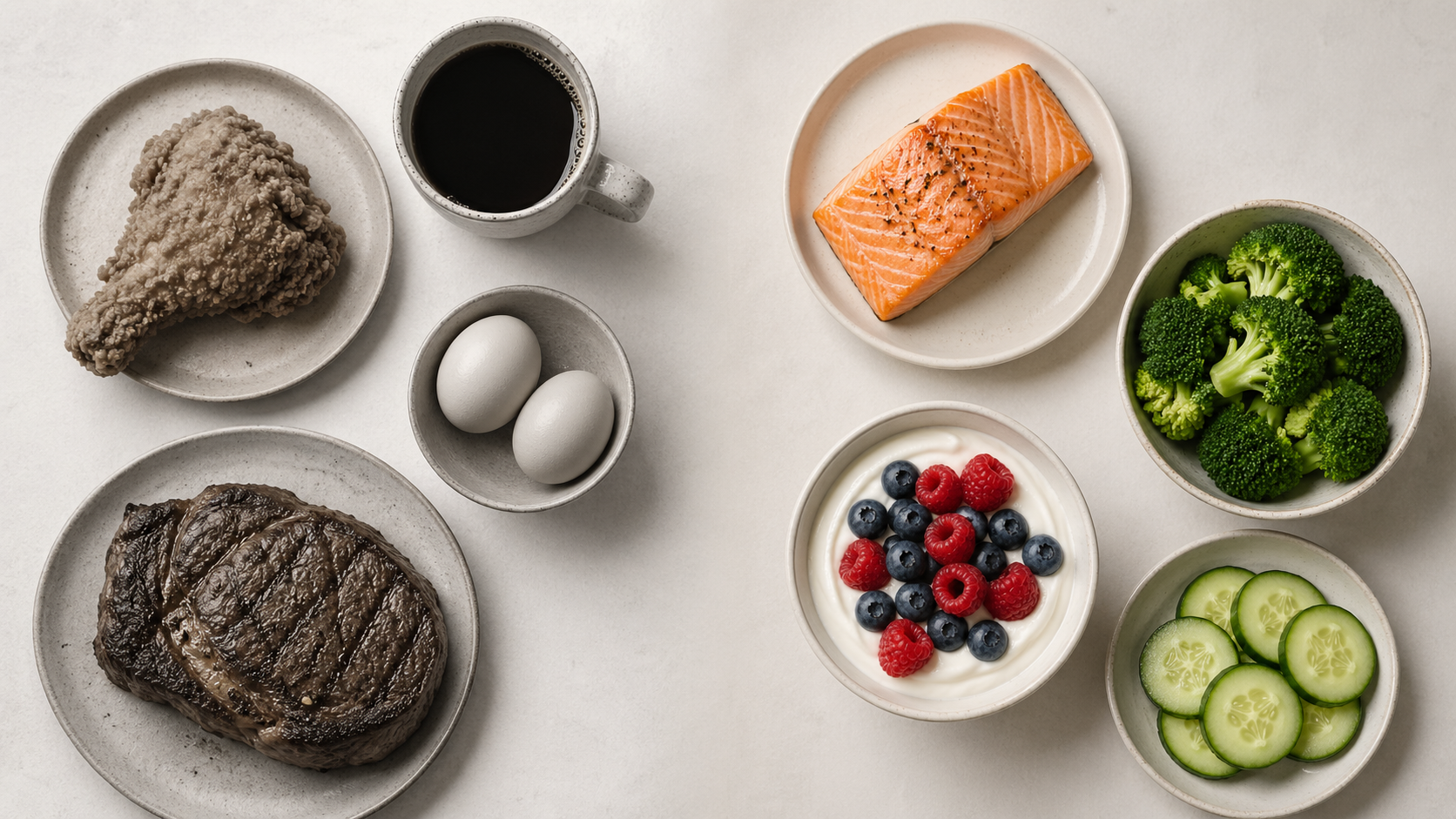
- Red meat — especially fattier cuts (ribeye, ground 80/20, sausage). Often described as "metallic" or "muddy."
- Eggs — particularly whole eggs and yolks. Some patients tolerate egg whites or egg-in-baked-goods but reject standalone scrambled or fried eggs.
- Coffee — about a quarter of patients lose their taste for coffee on a GLP-1, sometimes describing it as "smelling like garbage."
- Alcohol — many GLP-1 users dramatically reduce or stop drinking. Wine often goes first.
- Fried foods — fried chicken, French fries, anything heavily oil-based. The post-meal nausea is usually severe enough to create a Pavlovian aversion within a few exposures.
- Dairy (for some users) — particularly heavy cream, full-fat ice cream, mature cheeses. Lighter dairy (Greek yogurt, cottage cheese, mozzarella) usually stays acceptable.
- Sweet foods — even patients who used to love dessert often report that sweetness has become too much. Pure sugar feels unpleasant; concentrated fruit can be too intense.
This is not a list of foods you're forbidden from eating. These are simply the ones that, in aggregate, GLP-1 users report rejecting most often. Your individual list will be different — and it will change over time.
The foods that most users still tolerate well
Here's the inverse list — foods that, across the same patient communities, GLP-1 users consistently report still enjoying or tolerating well:
Proteins
- Salmon and other fatty fish — often the single most-tolerated protein source. Many patients report craving salmon when they couldn't tolerate any other protein.
- White-meat poultry — chicken breast, turkey breast (especially when grilled or roasted, not fried)
- Shrimp and other shellfish — light, easy to digest, no heavy fat
- Greek yogurt and cottage cheese — high protein, easy on the stomach, no chewing required
- Tofu and edamame — plant-protein with mild flavor, well tolerated
- Whey or pea protein powder — when mixed into shakes or oatmeal, often the easiest way to hit protein on a high-aversion day
Vegetables
- Broccoli, brussels sprouts, asparagus, green beans — patients report these consistently
- Cucumbers, bell peppers, snap peas — light, hydrating, neutral flavor
- Leafy greens — spinach, arugula, mixed greens
- Roasted vegetables (lower fat) — sweet potato, butternut squash
Fruits
- Berries — strawberries, blueberries, raspberries (often described as "the only sweet thing that still tastes good")
- Citrus — orange, grapefruit, lemon
- Melons — watermelon, cantaloupe (also great for hydration)
- Apples and pears — crisp, neutral
Grains and starches
- Oatmeal — gentle on the stomach, mild taste
- Quinoa — protein-leaning, mild
- Sourdough or whole-grain bread (small portions) — better tolerated than white bread or pastry
Drinks
- Water (often with cucumber, mint, or citrus)
- Plain or sparkling water with lemon
- Herbal tea
- Bone broth — many patients report this as a meal-replacement on bad-stomach days
The pattern: lean, mild, low-fat, often cool or room-temperature. Heat amplifies smell, which amplifies aversion. Many GLP-1 users find foods more tolerable cold than hot — chilled poached chicken, cold salmon, Greek yogurt, fruit.
How aversions change over time
Two things to know:
Aversions often shift week to week, especially after a dose increase. The eggs you couldn't stand at week 4 might be fine again at week 8, then disgusting again when you go up to the next dose. The pivotal STEP-1 trial (Wilding et al., N Engl J Med 2021) titrated semaglutide over 16 weeks specifically to manage GI tolerability, and most patients required dose adjustments along the way. Patients describe this dose-week instability as "the aversion roulette" — and it's why a fixed meal-kit subscription is hard to make work on a GLP-1.
Some aversions persist. Patient-community reports (Reddit + RD blog cohorts) indicate that a significant minority — roughly a third to nearly half — develop at least one food aversion that lasts for the duration of treatment, sometimes after stopping the medication. We have not yet seen this quantified in a peer-reviewed paper, so treat the specific number as patient-community signal rather than RCT evidence. The qualitative pattern, however, is well-documented: if red meat goes away and never comes back, you're typical, not broken.
For meal planning, this means flexibility matters more than commitment. A weekly plan you can adjust this Tuesday when something stops working is dramatically more useful than a four-week meal kit purchase.
How to plan around aversions without sacrificing nutrition
1. Treat protein as a category, not a specific food
Your protein floor is a daily gram count, not a specific recipe. If chicken is on your "ick" list this week, salmon and Greek yogurt and tofu cover the same nutritional ground. The patients who struggle most are the ones who tied their protein plan to one food (a chicken salad, a hard-boiled egg) and didn't have a fallback.
2. Lean into smoothies and shakes for hard days
A protein shake with frozen berries, Greek yogurt, and a spoon of nut butter delivers 25–30g of protein, fiber, and a meaningful calorie load in something cold, smooth, and easy to get down when chewing feels like work. Most GLP-1 users have at least one shake recipe they consider their "rescue meal."
3. Keep a 5-day "still works" list
Most patients can't tell you in the moment which 6 foods are working this week — but if you keep a running note (phone, fridge whiteboard, your meal planner), the pattern becomes obvious. If you've eaten salmon, Greek yogurt, broccoli, oatmeal, and cottage cheese all week without issue, those are your stable foundations. Build the next week around them.
4. Cold and bland is fine
Society tells you a "good meal" is hot, savory, and elaborate. On a GLP-1, that's often the meal you can't finish. Cold poached chicken with avocado on a piece of sourdough — eaten in five small bites over an hour — is genuinely a complete meal. Stop apologizing for eating like that.
5. Re-test occasionally, but not too often
Aversions can fade. Try a previously rejected food once every 4–6 weeks, in a small low-pressure portion. If it still triggers nausea or revulsion, leave it for another month. Don't force it; the negative association compounds.
When to flag aversions to your clinician
Most aversions are normal and don't require medical attention. But mention these to your prescribing clinician at your next visit:
- Any aversion that's so total you've gone more than two weeks below your protein floor
- Aversions accompanied by significant weight loss beyond what your dose targets (more than 1–2% per week sustained)
- Sudden new aversions that come with dizziness, fatigue, or confusion (could indicate dehydration or electrolyte imbalance)
- Aversions to entire food categories (e.g., "I can't tolerate any vegetables")
A registered dietitian can help you re-route around persistent aversions while keeping macros and micronutrients on track. If you don't have one, ask your prescriber for a referral — many insurance plans cover RD visits when prescribed alongside a GLP-1 medication.
How ThisWeekEats™ handles aversions
The structural problem with GLP-1 aversions is that they're moving. A meal-kit subscription locked in three months ago can't tell that this week, eggs aren't going to work for you. ThisWeekEats™ takes a different approach: each family member rates 169+ foods on their own profile, and you can update those ratings any week. The planner routes around what's currently on your "ick" list and pulls from what's currently working — and it re-plans the whole week in seconds when something changes.
The bottom line
- About 70% of GLP-1 users develop food aversions. You're not broken; this is the medication.
- Aversions are physiological — delayed gastric emptying, central appetite changes, and altered taste sensitivity all combine.
- The "still tolerated" foods for most patients: salmon, white-meat poultry, Greek yogurt, cottage cheese, berries, broccoli, oatmeal, water with citrus.
- Aversions shift week to week, especially after dose increases. Plan flexibly.
- Protein is a category, not a food — your daily gram floor matters; the specific protein source doesn't.
- Re-test occasionally, but don't force foods that consistently trigger nausea.
The patients who do best on Wegovy®, Ozempic®, Mounjaro®, and Zepbound® aren't the ones who white-knuckle through every aversion. They're the ones who route around their current "ick" list this week and trust that next month's list will look different.
Ready for a plan that bends with your aversions?
ThisWeekEats™ re-plans your week the moment something stops tasting right.
Peer-reviewed sources cited in this article
- Wilding JPH, Batterham RL, Calanna S, et al. Once-Weekly Semaglutide in Adults with Overweight or Obesity (STEP-1). N Engl J Med. 2021;384(11):989-1002. DOI: 10.1056/NEJMoa2032183
- Wharton S, Calanna S, Davies M, et al. Gastrointestinal tolerability of once-weekly semaglutide 2.4 mg in adults with overweight or obesity. Diabetes Obes Metab. 2022;24(1):94-105. DOI: 10.1111/dom.14551
- Mozaffarian D, Agarwal M, Aggarwal M, et al. Nutritional priorities to support GLP-1 therapy for obesity: A joint Advisory from the ACLM, ASN, OMA, and The Obesity Society. Obesity (Silver Spring). 2025;33(8):1475-1503. DOI: 10.1002/oby.24336
Patient-community signal references (not peer-reviewed; explicitly framed as such above): University of Pennsylvania Reddit analysis via MedicalXpress, SkinnyRx RD commentary.
Important medical & trademark disclaimer
This article cites peer-reviewed primary sources where possible and explicitly distinguishes patient-community signal from RCT evidence. It is general nutrition information, not medical advice, and does not create a provider-patient relationship. Individual reactions to a GLP-1 medication vary widely. Always consult your prescribing clinician and a registered dietitian before making dietary changes, especially while taking a prescription medication.
ThisWeekEats™ is not affiliated with, endorsed by, or sponsored by Novo Nordisk, Eli Lilly, or the makers of any GLP-1 receptor agonist medication. Wegovy® and Ozempic® are registered trademarks of Novo Nordisk. Mounjaro® and Zepbound® are registered trademarks of Eli Lilly. These names are used here solely to identify the medications our readers may be taking.
Ready to Experience AI Meal Planning?
Try ThisWeekEats free for 7 days. No credit card required.
Start Your Free Trial