
The Real Cost of 'What's for Dinner?' (Hint: It's More Than Money)
By ThisWeekEats Team
January 14, 2025
8 min read
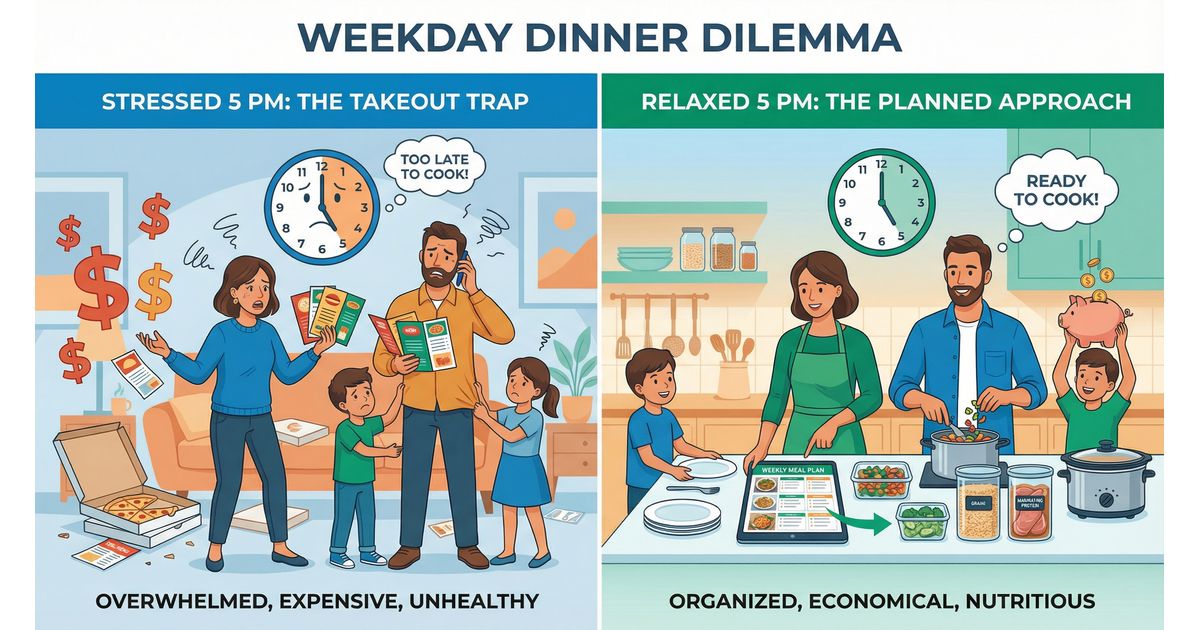
The Real Cost of 'What's for Dinner?' (Hint: It's More Than Money)
4:47 PM, Tuesday evening.
You're driving home from work. Your phone buzzes—your partner texts: "What's for dinner?"
You don't know. You haven't thought about it. You're tired.
Twenty minutes later, you're parked outside Chipotle. Again. That's $42 for the family. Again.
It wasn't supposed to go this way. You'd planned to cook at home this week. But somewhere between Monday's chaos and Tuesday's exhaustion, "meal planning" fell off the list.
Sound familiar?
The daily "what's for dinner?" question isn't just a minor inconvenience—it's a systemic drain on your time, money, mental energy, and overall well-being. Let's break down exactly what it's costing you.
The Financial Drain: $120-200 Per Month (Or More)
Let's start with the most obvious cost: money.
The Takeout Trap
Here's what most families don't realize: unplanned takeout isn't an occasional splurge—it's a recurring expense that quietly drains thousands from your budget annually.
Average cost per unplanned takeout meal:
- Fast food (McDonald's, Chick-fil-A): $30-40 for a family of 4
- Fast casual (Chipotle, Panera): $40-55
- Restaurant delivery (pizza, Chinese, Italian): $50-70
How often does this happen?
According to multiple studies, American families average 4-6 takeout/restaurant meals per week. Even conservative estimates suggest:
- 2 unplanned takeout meals per week = $80-120/week
- Monthly cost: $320-480
But wait—you planned to eat out once or twice for date night or convenience. The problem is the unplanned meals—the ones you grab because you didn't plan ahead.
Unplanned takeout (3x per week): $120-200/month Annual cost: $1,440-2,400
Home Cooking vs. Takeout: The Math
Now compare that to home-cooked meals:
Average cost per home-cooked meal:
- Budget-conscious ($5-8 per person): $20-32 for a family of 4
- Moderate ($8-12 per person): $32-48
- Flexible/Premium ($12+ per person): $48+
Even at the premium end, cooking at home costs 30-50% less than takeout.
Example Week Comparison:
| Scenario | Cost | |----------|------| | 7 takeout dinners (family of 4) | $280-420 | | 7 home-cooked dinners (moderate budget) | $224-336 | | Weekly savings: | $56-84 | | Monthly savings: | $224-336 | | Annual savings: | $2,688-4,032 |
The bottom line: Even if you cook at a moderate-to-premium budget, you'll save $200-300+ per month compared to frequent takeout.
And that's just dinner. Add breakfast and lunch, and the savings compound further.
The Meal Planning ROI
Now consider the cost of a meal planning solution:
- ThisWeekEats Premium: $9.99/month ($120/year)
- Savings from reduced takeout: $120-200+/month ($1,440-2,400/year)
ROI: 12-20x return on investment
For every dollar you spend on meal planning, you save $12-20 in avoided takeout costs.
The Time Drain: 3-5 Hours Per Week
Money is tangible. But time is irreplaceable.
Here's where those hours disappear:
1. Recipe Research & Decision-Making (1-2 hours/week)
- Scrolling Pinterest, food blogs, or recipe apps
- Comparing recipes for difficulty, ingredients, time
- Trying to remember what you made last week (to avoid repetition)
- Second-guessing whether the family will actually eat it
- Searching for substitutions for ingredients you don't have
Weekly time cost: 1-2 hours
2. Creating Shopping Lists (30-45 minutes/week)
- Writing down ingredients from each recipe
- Cross-checking your pantry to see what you already have
- Consolidating duplicate ingredients across recipes
- Organizing by grocery store section (or winging it and backtracking through aisles)
- Inevitably forgetting something critical
Weekly time cost: 30-45 minutes
3. Multiple Grocery Trips (30-60+ minutes/week)
Because you forgot an ingredient, or because you didn't plan ahead and need to make emergency runs:
- Planned shopping trip: 45-60 minutes
- Emergency trip(s) for forgotten items: +15-30 minutes per trip
Weekly time cost: 30-60+ minutes
4. Daily "What's for Dinner?" Debates (15-20 minutes/day)
The daily ritual:
- "What do you want for dinner?"
- "I don't know, what do you want?"
- "We had that last week."
- "I'm too tired to cook something complicated."
- "Fine, let's just order something."
Multiply by 7 days.
Weekly time cost: 1.5-2 hours
Total Time Drain: 3.5-5.5 Hours Per Week
That's 175-275 hours per year—equivalent to 4-7 full work weeks—spent just thinking about meals.
What could you do with an extra 200 hours per year?
- Learn a new skill
- Spend quality time with family
- Read 30-40 books
- Exercise regularly
- Actually relax
The Mental Load: The Hidden Drain on Your Well-Being
Time and money are measurable. But there's a third cost that's harder to quantify: mental energy.
Decision Fatigue Is Real
Research shows that the average adult makes 35,000 decisions per day. Of those, over 200 are food-related.
Every decision depletes your mental reserves:
- What to eat
- When to shop
- What to buy
- How to prepare it
- What to do with leftovers
This is called decision fatigue, and it has real consequences:
- Reduced willpower: Later decisions become harder (ever notice you make worse food choices at night?)
- Increased stress: Constant low-level anxiety about meals
- Analysis paralysis: Overthinking simple decisions until they feel impossible
- Relationship tension: "I don't know, what do you want?" arguments
The Invisible Labor of Meal Planning
Sociologists call this invisible labor—the unnoticed, uncompensated work that keeps households running.
For many families, one person (often mothers) carries the majority of this burden:
- Remembering everyone's preferences
- Tracking dietary restrictions
- Planning nutritionally balanced meals
- Managing the grocery budget
- Coordinating schedules
It's exhausting. And it's often invisible to everyone except the person doing it.
The Nutritional Cost: When Convenience Beats Health
When you're exhausted from decision-making, convenience wins over nutrition.
The Convenience Spiral
Here's how it typically happens:
- Monday: You're motivated. You cook a healthy, balanced meal.
- Tuesday: You're tired. You opt for pasta (easy, but carb-heavy).
- Wednesday: You're exhausted. You order pizza.
- Thursday: You feel guilty. You try to cook, but it's stressful.
- Friday: You've given up. Takeout again.
The result? A diet that's:
- Higher in calories: Restaurant meals average 50-100% more calories than home-cooked equivalents
- Higher in sodium: 2-3x the recommended daily intake
- Lower in vegetables: Most takeout lacks adequate produce
- Lower in variety: You default to the same 5-7 takeout places
Over time, this impacts health, energy levels, and well-being.
Why Nutrition Suffers Without Planning
When you don't plan, you default to:
- What's easiest: Pasta, rice, sandwiches (often imbalanced macros)
- What's fastest: Pre-packaged meals, frozen dinners (often high in sodium)
- What's familiar: The same rotation of 5-7 meals (lacks nutritional diversity)
Balanced nutrition requires planning. Without it, you're winging it—and your health pays the price.
The Opportunity Cost: What You're Missing Out On
Beyond the direct costs, there's what economists call opportunity cost—what you give up by spending resources (time, money, energy) on meal planning stress.
Time You Could Spend on What Matters
Those 3-5 hours per week spent meal planning? You could be:
- Playing with your kids
- Exercising
- Pursuing hobbies
- Advancing your career
- Actually relaxing
Money You Could Invest Elsewhere
That $120-200/month in unplanned takeout? You could be:
- Building an emergency fund
- Saving for a family vacation
- Paying off debt
- Investing in your future
Mental Energy You Could Direct Productively
That constant low-level anxiety about dinner? You could redirect it toward:
- Creative projects
- Problem-solving at work
- Being present with loved ones
- Personal growth
The Solution: Cooking at Home IS Always Cheaper (And Easier with the Right System)
You already know that cooking at home is cheaper. The problem isn't knowledge—it's execution.
Traditional meal planning requires you to:
- Do the mental work (deciding what to cook)
- Do the organizational work (shopping lists, ingredient tracking)
- Do the nutritional work (balancing meals)
No wonder you're exhausted.
AI-powered meal planning changes the equation.
Instead of you doing all the cognitive work, the system:
- Decides what to cook (based on your family's preferences)
- Creates shopping lists (automatically, in seconds)
- Balances nutrition (following evidence-based guidelines)
- Learns from feedback (gets better over time)
You still cook at home (and save money). But you eliminate the thinking, planning, and stress.
The Real ROI: Time + Money + Mental Freedom
Let's revisit the numbers:
Monthly costs:
- Unplanned takeout: $120-200
- AI meal planning (ThisWeekEats): $9.99
- Net savings: $110-190/month
Time savings:
- Traditional meal planning: 3-5 hours/week
- AI meal planning: <5 minutes/week
- Time reclaimed: 3-5 hours/week (150-250 hours/year)
Mental energy:
- Traditional meal planning: Daily stress, decision fatigue
- AI meal planning: Set it and forget it
The true ROI isn't just financial—it's time, energy, and peace of mind.
What If You Could Get Those Hours (and Dollars) Back?
Imagine:
- No more 5 PM panic about what's for dinner
- No more grocery store guesswork (wondering if you're forgetting something)
- No more guilt about ordering expensive takeout
- No more debates with your partner about meal decisions
- No more boring meal rotation (eating the same 5 things forever)
Just:
- Open the app
- See your meal for tonight
- Cook (or don't—the plan is there when you need it)
- Eat well, save money, reclaim your time
That's the promise of AI meal planning. And it's one that thousands of families are already experiencing.
Ready to Reclaim Your Time and Budget?
Try ThisWeekEats free for 7 days. See exactly how much time and money you save when meal planning runs on autopilot.
Medical Disclaimer
This article provides general information about meal planning and nutrition. Individual nutritional needs vary based on age, health conditions, activity level, and other factors. Always consult with a registered dietitian, physician, or other qualified healthcare professional for personalized dietary guidance, especially if you have existing health conditions, food allergies, or specific dietary requirements.
Ready to Experience AI Meal Planning?
Try ThisWeekEats free for 7 days. No credit card required.
Start Your Free Trial