
How to Portion a Casserole or One-Pot Meal (Without Losing Your Mind)
By ThisWeekEats Team
June 25, 2026
6 min read
How to Portion a Casserole or One-Pot Meal (Without Losing Your Mind)
A single chicken breast is easy. One person, one piece, done.
A bubbling 9×13 pan of enchilada casserole? A pot of chili? A sheet-pan stir-fry tossed with sauce? That's where people start to sweat. "It says this serves 4 at 540 calories each — but how do I know my scoop is exactly one-quarter of the pan? What if my husband's plate has more cheese? What if I gave the kids too much rice?"
We hear this a lot. So let's settle it plainly:
You cannot divide a mixed dish into exact, identical portions. Nobody can. And the good news is that you don't need to — not even a little.
This isn't us shrugging. It's the actual science of food, and once you see it, the anxiety tends to melt off. Here's why, and here's the dead-simple way to serve a shared dish.
Why a Casserole Can't Be Portioned Precisely
A chicken breast is one ingredient with the calories spread evenly through it. A casserole is the opposite: it's a suspension of unevenly distributed parts. The cheese pools toward one corner. The oil and sauce sink to the bottom. The sausage didn't land in equal amounts across every square inch. The crispy top has different density than the soft middle.
So when a recipe says "serves 4, 540 calories each," that number is the whole pan's calories divided by four — an average. The four real plates that come out of that pan might genuinely be 470, 510, 560, and 620 calories. Not because anyone measured wrong, but because the food refuses to be uniform. There is no scoop, scale, or technique that fixes this. The unevenness is baked in — literally.
Chasing "exactly one-quarter" of a casserole is like trying to cut a cloud into four equal pieces. The target doesn't exist.
The Number You're Chasing Is Already an Estimate
Here's the part that surprises people most. Even if you could portion the pan perfectly, the calorie number itself was never exact to begin with:
- The FDA legally allows a packaged food to contain up to 20% more calories than its label claims. That box of pasta you weighed to the gram? Its "200 calories per serving" can legally be 240 and still count as an "accurate" label (21 CFR 101.9). Your scale is precise. The number you're feeding it is not.
- The calorie math everything uses is a 100-year-old average. Every nutrition database runs on "Atwater factors" — roughly 4 calories per gram of protein and carbs, 9 per gram of fat. Those are population averages from the early 1900s, not a measurement of your specific block of cheese.
- Your own body doesn't measure precisely either. Two people can eat the identical 540-calorie serving and absorb meaningfully different amounts, depending on gut bacteria, how cooked the food was, and how well it was chewed.
So the precision-weigher is using a perfect scale to measure an imperfect number, then feeding it to a body that processes it imperfectly. Three layers of fuzz, and only the middle one ever gets the attention.
(We go deeper on this in Why Calorie Numbers Vary — worth a read if exact numbers are your thing.)
The Only Thing That Actually Matters: The Week, Not the Plate
Your body keeps its books over weeks, not meals. Weight, energy, and health respond to the rolling average of what you eat — not to whether Tuesday's dinner was 540 or 610.
Think about what naturally happens at a real dinner table:
- Tonight your plate runs a little heavy on the cheesy corner: +80 calories.
- Tomorrow you take the thinner edge piece: −80 calories.
- Some nights you go back for a half-scoop more; some nights you don't finish.
Over a week, these swings cancel out. That's not sloppiness — that's how eating has worked for all of human history, long before anyone owned a food scale. A 10% wobble on a single dinner is invisible against your weekly total. It's noise. The trend is the signal.
If you're hitting roughly the right portions most nights, you are already doing it correctly. There is no bonus prize for matching a decimal that the food itself can't honor.
The Simple Way to Serve a Shared Dish
Forget scoops and grams. Here's how to portion a casserole or one-pot meal the way it actually works:
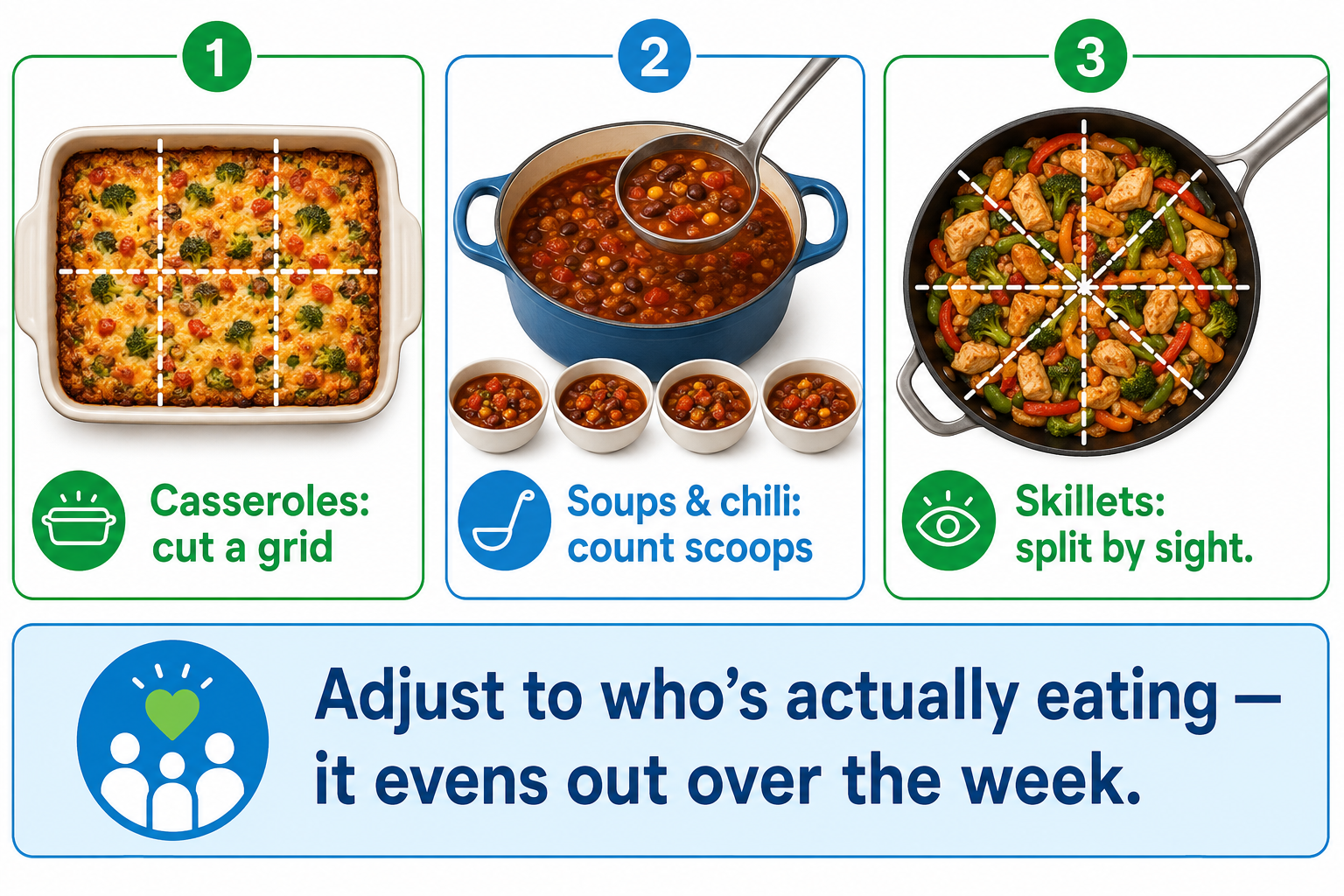
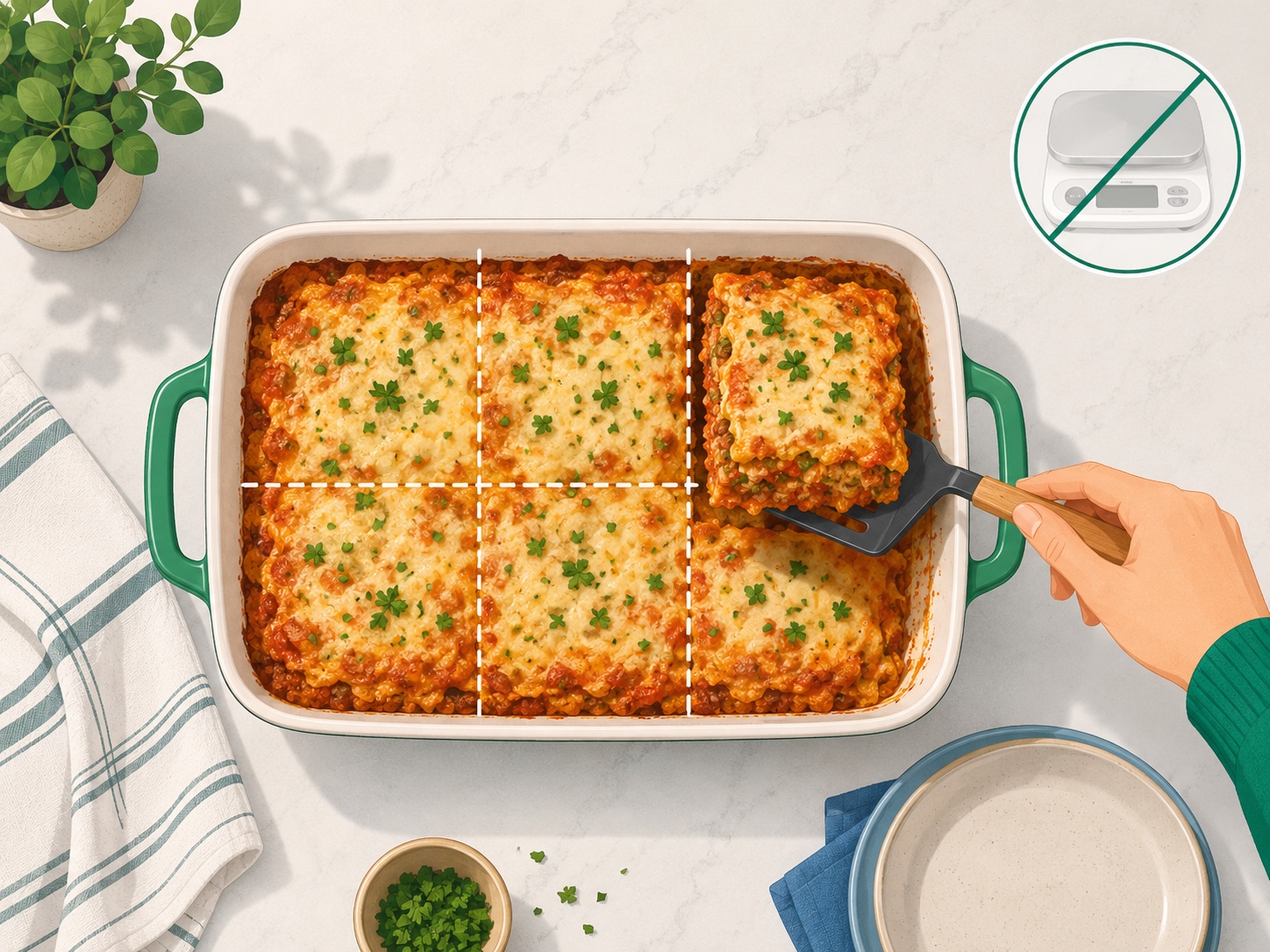
For casseroles, bakes, and sheet-pan meals — cut a grid. Mentally slice the pan into the number of servings the recipe makes. A 9×13 that "serves 6"? Score it into 6 roughly-equal rectangles (a 2×3 grid). Bigger eaters take a full piece; smaller eaters or kids take a partial. You just portioned the whole pan in five seconds, no scale required.
For chili, soup, and stews — count scoops. A standard ladle is about a cup. Recipe serves 4? The pot holds roughly 4 big ladles per serving's worth — give adults a couple of scoops, kids one. Eyeball it; it evens out.
For stir-fries and skillet meals — split by sight. Push the food into equal-looking piles in the pan, or just plate until each looks proportional to who's eating. Adults get more, kids get less. Done.
Then adjust to the actual human. A teenager after practice gets more than a 6-year-old. That's not breaking the plan — that's following it. The serving count is a starting point, not a rule you're violating.
A Note for the Perfectionist
If you genuinely love weighing your food — keep doing it. It can build useful awareness, and there's nothing wrong with it. Just know what the scale can and can't give you: it gives you consistency with yourself, which is real and valuable. It does not give you a true, exact calorie count of a casserole serving, because — as above — that exact number doesn't exist to be found.
So weigh if it helps you feel in control. But if a casserole ever has you stuck, frustrated, or skipping a meal you wanted because you "can't portion it right" — that's the precision working against you, not for you. Cut the grid. Take your piece. Trust the week.
TL;DR
- You can't portion a casserole or one-pot meal precisely — the cheese, oil, and sauce distribute unevenly, so identical servings physically don't exist.
- The calorie number was never exact anyway — the FDA allows ±20% on labels, the underlying math is a century-old average, and your body absorbs imprecisely.
- Your body averages over weeks, not meals. A 10% swing on one dinner is noise; the trend is what counts. The over-portioned night and the under-portioned night cancel out.
- Just serve it sensibly: cut casseroles into a grid, count scoops for soups, split skillets by sight, and adjust to who's actually eating.
- Close, over the week, is the real gold standard. Exact, every plate, is a myth — and a stressful one. Let it go.
Your meal plan gives you the serving counts and the per-person targets. Use them as a confident starting point, dish up like a normal human, and spend your energy on the food — not the decimals.
Ready to Experience AI Meal Planning?
Try ThisWeekEats free for 7 days. No credit card required.
Start Your Free Trial