
How Much Protein Do You Actually Need on Mounjaro®?
By ThisWeekEats Team
April 28, 2026
9 min read
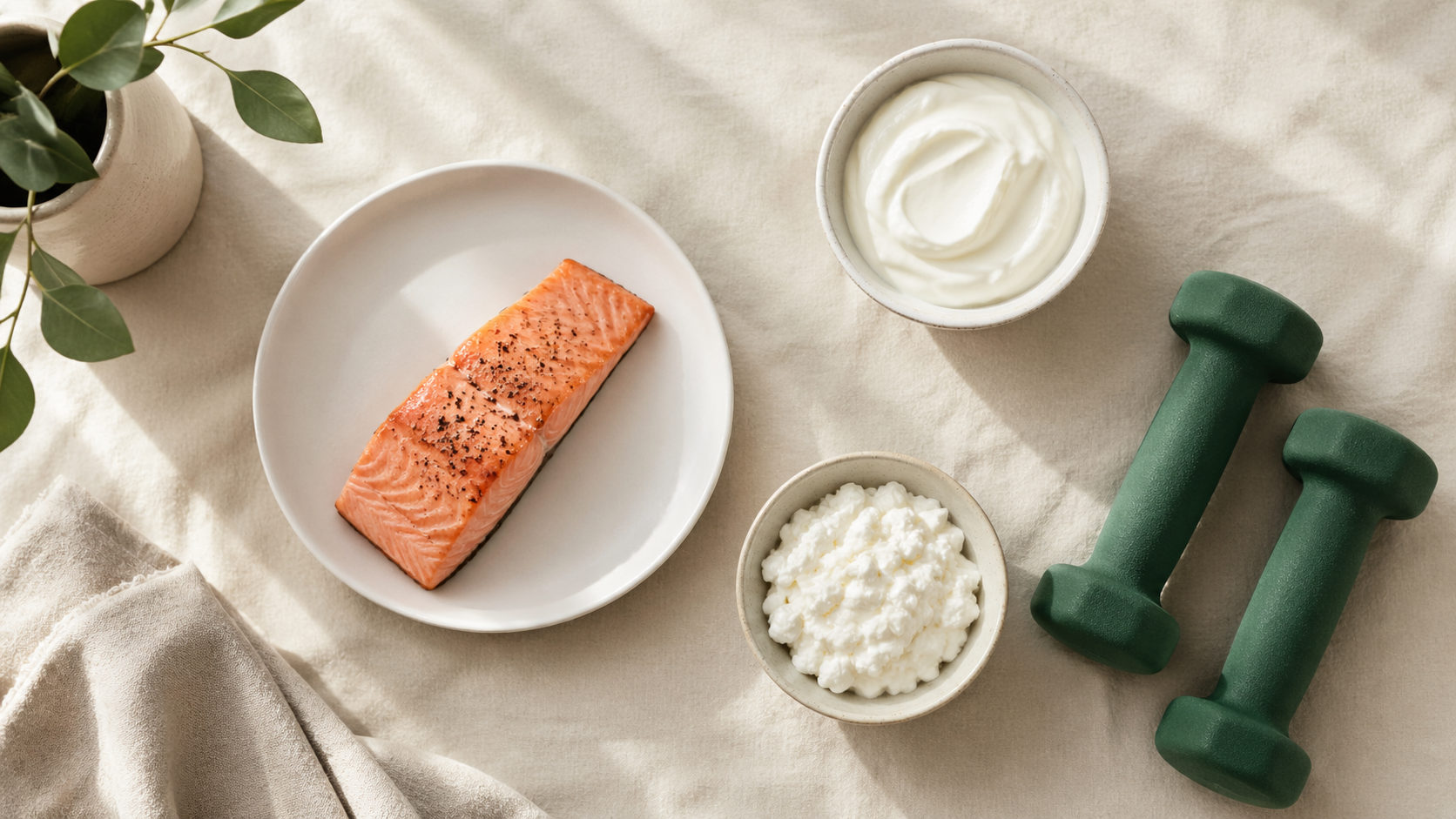
How Much Protein Do You Actually Need on Mounjaro®?
If you started Mounjaro® or Zepbound® in the last few months, you've probably already noticed that the appetite suppression is faster and harder than what you read about with semaglutide. Tirzepatide — the active drug in both — hits two appetite-regulating receptors at once (GLP-1 and GIP), and the side-effect ramp is steeper than people expect.
The single most important number to keep in your head while you're on it is your daily protein floor. Get this wrong and a meaningful chunk of the weight you lose won't be fat — it'll be muscle, hair, skin, and the small amount of bone density that maintains your face and posture.
This article is the practical, registered-dietitian-aligned answer to: exactly how much protein do I need, and how do I actually get it down when I can barely eat?
The category-defining number
Roughly 20–40% of the weight lost on a GLP-1 receptor agonist can be lean body mass, depending on the trial protocol and how aggressively patients managed protein intake and resistance training.
The best-controlled body-composition data we have comes from the SURMOUNT-1 DXA substudy (Look et al., Diabetes Obes Metab 2025), which reported that approximately 75% of the weight lost was fat mass and 25% was lean mass — for both tirzepatide and placebo. A broader systematic review of semaglutide trials (Bikou et al., Expert Opin Pharmacother 2024) found "notable reductions ranging from almost 0% to 40% of total weight reduction" in lean mass, depending heavily on the protocol.
The take-home: the 25% figure represents what happens with average care; the 40% upper bound is what happens when no one is watching protein and movement. Where you land in that range is the part you actually control. The 2025 joint advisory from the American College of Lifestyle Medicine, American Society for Nutrition, Obesity Medicine Association, and The Obesity Society (Mozaffarian et al., Obesity 2025) lists adequate protein intake and strength training to preserve lean mass as one of its eight top nutritional priorities for GLP-1 patients — for exactly this reason.
You went on Mounjaro® to lose fat. You did not sign up to lose your hair, your face, or your ability to climb stairs in five years.
The two numbers that matter
1. The daily floor: 1.2 grams of protein per kilogram of body weight
The 1.2 g/kg/day floor isn't a marketing number — it's the canonical recommendation from the PROT-AGE Study Group expert consensus (Bauer et al., J Am Med Dir Assoc 2013), which established that adults need "an average daily intake at least in the range of 1.0 to 1.2 g protein per kilogram of body weight per day," with higher intake (1.2–1.5 g/kg/d) for adults with acute or chronic disease — which is the population on a GLP-1 medication. The mechanistic rationale for protein's role specifically during weight loss is laid out in Cava et al., Adv Nutr 2017: "High protein intake helps preserve lean body and muscle mass during weight loss... both endurance- and resistance-type exercise help preserve muscle mass."
Quick math:
| Your weight | Floor (1.2 g/kg) | Higher target (1.5 g/kg) | |---|---|---| | 120 lb (54 kg) | 65 g/day | 81 g/day | | 150 lb (68 kg) | 82 g/day | 102 g/day | | 180 lb (82 kg) | 98 g/day | 122 g/day | | 220 lb (100 kg) | 120 g/day | 150 g/day | | 250 lb (113 kg) | 136 g/day | 170 g/day |
Use the higher target (1.5 g/kg) if any of the following apply:
- You're over 65
- You have a comorbidity that affects protein synthesis (kidney issues, certain cancers, sarcopenia)
- You're doing resistance training (which you should be — see below)
- Your dose recently increased and your appetite cratered
2. The per-meal target: 20–40 grams at a single sitting
This is the number most GLP-1 patients miss. Your body can only use so much protein at one sitting for muscle protein synthesis (MPS). The classic dose-response work (Moore et al., Am J Clin Nutr 2009) showed that 20 g of high-quality protein is sufficient to maximally stimulate MPS in young men after resistance exercise — doses higher than that drive amino acid oxidation, not additional muscle synthesis. For adults over 40 and especially over 65, a slightly higher per-meal target (~30–40 g, or 0.40 g/kg per eating occasion) is generally recommended to overcome anabolic resistance.
What that means in practice: scarfing 100 grams of protein at dinner doesn't fix a 30-gram lunch. The body uses the first ~40 grams for muscle, and the rest mostly gets oxidized for energy.
So the daily total has to be split. Five or six small eating occasions of 20–30 grams each is far more useful than three big meals of 50+ grams.
For someone on Mounjaro® who can only eat "two bites" at a sitting, this is actually good news: small + frequent is exactly what your body wants anyway.
What 25 grams of protein looks like when you can barely eat
Concrete examples — pick any one of these and you've hit a per-meal target:
- 3 oz cooked chicken breast (about the size of a deck of cards)
- 4 oz cooked salmon
- 1 cup of plain Greek yogurt + 1 tablespoon of hemp seeds
- 3 large eggs + 1 oz cheese
- 1 cup of cottage cheese
- 1 scoop of whey protein (24g) in water or unsweetened almond milk
- 6 oz of plain cottage cheese + 1 oz almonds
- 4 oz lean ground turkey browned and seasoned
- 1 cup of edamame + ¾ cup of tofu
Notice what's missing from this list: bacon, sausage, cured meats, fried anything, heavy ground beef, cheesy casseroles. Those have protein, but they also have the saturated fat and processed-meat profile that triggers the worst Mounjaro® GI side effects (more on that below).
The five-meal day, planned
Here's a sample day at the 1.2 g/kg target for a 180-lb adult (98g protein/day, ~1,400 kcal). Notice the protein is roughly evenly distributed and no single meal asks you to eat more than your stomach can handle.
| Time | Meal | Protein | |---|---|---| | 7am | Greek yogurt (¾ cup) + chia seeds + berries | 20g | | 10am | Hard-boiled egg + 1 oz string cheese | 13g | | 12:30pm | Grilled chicken (3 oz) over arugula, lemon, olive oil | 25g | | 3pm | Cottage cheese (½ cup) + cucumber slices | 13g | | 6:30pm | Baked salmon (4 oz) + steamed broccoli + ½ cup quinoa | 28g | | Total | | 99g |
This isn't a recipe prescription — it's a structural example. The point: five small touchpoints, each in the 13–28g range, none of them demanding heroics from a stomach that doesn't feel hungry.
Why tirzepatide makes this harder than semaglutide
Mounjaro® and Zepbound® aren't just "stronger Ozempic®." Tirzepatide hits both GLP-1 and GIP receptors, and the GIP component is part of why it produces both faster weight loss and more intense GI side effects in the early weeks of a new dose. The pivotal SURMOUNT-1 trial (Jastreboff et al., N Engl J Med 2022) reported mean weight loss at 72 weeks of −15.0% (5 mg), −19.5% (10 mg), and −20.9% (15 mg) versus −3.1% with placebo. The pooled GI tolerability analysis for semaglutide (Wharton et al., Diabetes Obes Metab 2022) found nausea in 43.9% of patients, diarrhea in 29.7%, vomiting in 24.5%, and constipation in 24.2% — and tirzepatide users typically report similar or higher incidences in their first weeks.
The most common complaints among tirzepatide users include:
- Stronger nausea, especially after fatty or fried meals
- More pronounced "sulfur burps" (the rotten-egg burps from delayed gastric emptying)
- Earlier and more total satiety — patients often describe being "full after 4 bites"
- Greater food aversions, particularly to red meat, eggs, and coffee
For protein, this means: the foods you'd normally rely on for high-density protein (steak, eggs, sausage, ground beef) are exactly the ones tirzepatide is most likely to make you reject. Your protein plan needs to lean on the foods that GLP-1 users still tolerate well: fish, white-meat poultry, Greek yogurt, cottage cheese, edamame, tofu, and protein powders mixed into smoothies or shakes.
Resistance training is not optional
Protein alone doesn't preserve muscle. The signal your body needs to keep lean mass while losing weight is mechanical loading — resistance training, two to three times per week.
The most striking evidence on this point comes from Longland et al., Am J Clin Nutr 2016 — a 4-week trial in young men eating at a 40% caloric deficit while training hard. The high-protein arm (2.4 g/kg/day) gained 1.2 kg of lean mass and lost 4.8 kg of fat, while the lower-protein arm (1.2 g/kg/day) preserved muscle but didn't build it. Read that again: in a steep deficit, with both protein and heavy training, the lean-mass curve actually went up.
That's an extreme deficit and an extreme training protocol — not realistic for most GLP-1 patients in their first months. But the lesson generalizes: the protein math above is calibrated for someone doing some form of resistance work. Without it, even hitting 1.2 g/kg won't fully prevent the muscle loss range the trials report.
If you're not currently lifting anything heavier than groceries, the easiest entry point most patients tolerate well is a beginner full-body routine, two days per week, focused on compound movements (squats, hinges, presses, pulls). Talk to your prescribing clinician before starting if you have any existing musculoskeletal issues.
Common mistakes patients make
Counting incomplete proteins as full servings
Almonds, peanut butter, and bread have protein listed on the label, but the bioavailability and amino acid completeness are lower than animal sources or soy. They count toward your day, but a tablespoon of peanut butter (4g) is not a meaningful protein meal — it's a snack.
Skipping breakfast
This is the single biggest pattern we see. Patients are least hungry in the morning, so they skip breakfast, then "make it up" at dinner. But the per-meal cap means you can't make it up. A 20-gram breakfast is the foundation of a 100-gram day.
Relying on fried high-protein foods
Fried chicken, breaded fish, sausage — high in protein on paper, but the fat profile triggers the worst Mounjaro® GI symptoms and crowds out the calories you needed for actual nutrient density.
Assuming the meal-replacement shake is enough
A whey shake is a great floor-setter (24g in 200 calories), but living on shakes doesn't give you the fiber, micronutrients, or chewing-and-satiety signals your body needs over a multi-month course. Use shakes to backstop bad days, not as the primary plan.
Where ThisWeekEats™ fits
If you're on tirzepatide, you're probably already exhausted by figuring out three meals a day around an appetite that changes from week to week. ThisWeekEats™ plans the week for you — anchored on your protein floor, split into 5–6 small eating occasions, and routed around the foods you can't tolerate this week. When the eggs suddenly taste wrong on Tuesday, you re-rate them; the rest of the week re-plans automatically.
What to take to your dietitian or clinician
If you don't already have a registered dietitian on your care team, get one. Most insurance plans cover RD visits when prescribed alongside a medication like Mounjaro®. Bring this checklist to your first appointment:
- Your weight in kilograms and your current daily protein average (food diary helps)
- Your dose and the dates of each titration
- Side effects you're currently dealing with (GI, food aversions, fatigue)
- Any resistance training you're doing or want to start
- Family history relevant to muscle and bone health
Your RD will personalize the targets above to your bloodwork, comorbidities, and goals. Software (us included) doesn't replace that.
The bottom line
- Daily floor: 1.2 g of protein per kg of body weight. Higher (1.5 g/kg) if you're over 65 or training hard.
- Per-meal cap: 25–40 g. Spread across 5–6 small eating occasions.
- Lean on tolerable foods. Fish, white-meat poultry, Greek yogurt, cottage cheese, edamame, tofu, whey protein.
- Resistance training, twice a week. Protein without loading doesn't fully prevent muscle loss.
- A registered dietitian, prescribing clinician, and a structured weekly plan are the three pillars.
The patients who do well on Mounjaro® and keep the weight off when they eventually taper or stop the medication are the ones who used the GLP-1 window to build their nutrition habits, not skip them. Protein is the entry point.
Ready to plan your protein-first GLP-1 week?
ThisWeekEats™ is built around the math in this article — daily protein floor enforced, small meals planned to fit a GLP-1 stomach, foods routed around your aversions.
Peer-reviewed sources cited in this article
- Bauer J, Biolo G, Cederholm T, et al. Evidence-based recommendations for optimal dietary protein intake in older people: a position paper from the PROT-AGE Study Group. J Am Med Dir Assoc. 2013;14(8):542-559. DOI: 10.1016/j.jamda.2013.05.021
- Cava E, Yeat NC, Mittendorfer B. Preserving Healthy Muscle during Weight Loss. Adv Nutr. 2017;8(3):511-519. DOI: 10.3945/an.116.014506
- Moore DR, Robinson MJ, Fry JL, et al. Ingested protein dose response of muscle and albumin protein synthesis after resistance exercise in young men. Am J Clin Nutr. 2009;89(1):161-168. DOI: 10.3945/ajcn.2008.26401
- Longland TM, Oikawa SY, Mitchell CJ, Devries MC, Phillips SM. Higher compared with lower dietary protein during an energy deficit combined with intense exercise promotes greater lean mass gain and fat mass loss. Am J Clin Nutr. 2016;103(3):738-746. DOI: 10.3945/ajcn.115.119339
- Jastreboff AM, Aronne LJ, Ahmad NN, et al. Tirzepatide Once Weekly for the Treatment of Obesity. N Engl J Med. 2022;387(3):205-216. DOI: 10.1056/NEJMoa2206038
- Look M, Dunn JP, Kushner RF, et al. Body composition changes during weight reduction with tirzepatide in the SURMOUNT-1 study. Diabetes Obes Metab. 2025;27(5):2720-2729. DOI: 10.1111/dom.16275
- Bikou A, Dermiki-Gkana F, Penteris M, et al. A systematic review of the effect of semaglutide on lean mass: insights from clinical trials. Expert Opin Pharmacother. 2024;25(5):611-619. DOI: 10.1080/14656566.2024.2343092
- Wharton S, Calanna S, Davies M, et al. Gastrointestinal tolerability of once-weekly semaglutide 2.4 mg in adults with overweight or obesity. Diabetes Obes Metab. 2022;24(1):94-105. DOI: 10.1111/dom.14551
- Mozaffarian D, Agarwal M, Aggarwal M, et al. Nutritional priorities to support GLP-1 therapy for obesity: A joint Advisory from the ACLM, ASN, OMA, and The Obesity Society. Obesity (Silver Spring). 2025;33(8):1475-1503. DOI: 10.1002/oby.24336
Important medical & trademark disclaimer
This article cites peer-reviewed primary sources and consensus advisories from major nutrition and obesity-medicine societies. It is general nutrition information, not medical advice, and does not create a provider-patient relationship. Individual protein, calorie, and hydration targets vary with age, weight, comorbidities, and medication, and require personalized professional guidance. Always consult your prescribing clinician and a registered dietitian before changing your diet, especially while taking a GLP-1 medication.
ThisWeekEats™ is not affiliated with, endorsed by, or sponsored by Eli Lilly, Novo Nordisk, or the makers of any GLP-1 receptor agonist medication. Mounjaro® and Zepbound® are registered trademarks of Eli Lilly. Ozempic® and Wegovy® are registered trademarks of Novo Nordisk. These names are used here solely to identify the medications our readers may be taking.
Ready to Experience AI Meal Planning?
Try ThisWeekEats free for 7 days. No credit card required.
Start Your Free Trial